MEXC Global Card Explained: Cashback, M-Score and the September 30 Fee Deadline
How MEXC Global Card cashback, M-Score tiers and monthly caps work, what the 1% fee from October 1 costs, and why the 7% Card Earn product is separate.
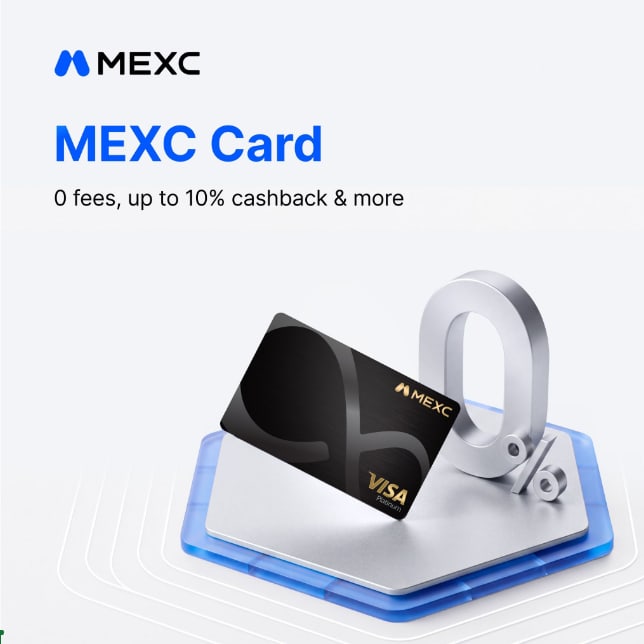
MEXC promotional image of the black MEXC Visa Platinum card, with the tagline "0 fees, up to 10% cashback & more"
MEXC launched its Global Card on August 31, 2026, adding a virtual Visa Platinum card alongside its existing APAC product.
The headline offer is strong: up to 10% cashback, a temporary 0% transaction fee and access to a separate Card Earn product currently offering 7% APR. But those benefits work differently. Cashback depends on MEXC's M-Score system and monthly caps, the 0% transaction-fee promotion is scheduled to end on September 30, and the 7% APR applies only to USDT separately subscribed through MEXC Earn.
Here is what card users need to know.
How the MEXC Global Card works
The Global Card is a custodial virtual Visa Platinum card funded with USDT through a MEXC account. Users first move USDT into their Fiat Account and then top up a separate Global Card balance. Purchases draw from that funded balance rather than directly from Spot or Futures holdings.
The card currently supports Apple Pay and Google Pay. It is virtual-only and does not support ATM withdrawals. Funds loaded for spending remain within MEXC's custodial infrastructure rather than in a user-controlled wallet.
Cashback ranges from 4% to 10%
MEXC Global Card cashback is linked to the user's VVIP tier and M-Score:
- Standard: M-Score 350–599 | 4% cashback | 100 USDT monthly cap
- Premier: M-Score 600–799 | 6% cashback | 300 USDT monthly cap
- Elite: M-Score 800+ | 10% cashback | 800 USDT monthly cap
These are cashback caps, not spending caps. At the published rates, users would reach the maximum monthly cashback after approximately:
- $2,500 of eligible spending at Standard
- $5,000 at Premier
- $8,000 at Elite
Cashback is paid in USDT to the user's Spot Account by the 15th of the following month. The applicable rate and cap are determined by the user's actual VVIP tier on the final day of the calendar month. Temporary Elite Experience Card status does not qualify for Elite Card cashback.
Not every transaction qualifies. Certain financial services, crypto or wallet funding, securities purchases and other excluded merchant categories do not earn cashback. Refunded or reversed transactions are also excluded.
What M-Score actually means
MEXC confirmed to CryptoCards.one that following the VVIP relaunch, the programme is no longer restricted to invited users. An older MEXC FAQ still contains invitation-only wording that has not yet been updated.
New users receive a starting M-Score of 350, corresponding to Standard, one day after registration. This currently unlocks the 4% Card cashback tier without requiring a specified minimum asset balance or trading-volume threshold.
Existing users can start higher. MEXC says previous trading behaviour, assets and account activity can already contribute to their score, meaning an established user could enter at 600 or above.
Premier requires an M-Score of 600 and Elite requires 800, but there is no simple public formula based on a specific asset balance or trading volume. M-Score is dynamic and considers factors including trading, account assets, security settings and platform activity.
The 0% transaction fee ends September 30
The Global Card's standard 1% transaction fee is currently waived through September 30, 2026. Unless MEXC extends or changes the promotion, the standard 1% fee applies from October 1.
Before considering FX or other costs, subtracting that fee from the headline cashback gives a simple net reward of approximately:
- Standard: 3%
- Premier: 5%
- Elite: 9%
These are not alternative cashback rates. They simply illustrate the effect of the 1% transaction fee while a user remains below their monthly cashback cap. Once the cap is reached, cashback stops while the transaction fee continues to apply to further spending.
FX and other card fees
MEXC says the Global Card does not charge a separate crypto-conversion fee or add its own markup to Visa's exchange rate. If a purchase requires currency conversion, Visa's applicable exchange rate still determines the conversion. Merchant dynamic currency conversion can also introduce additional costs if selected.
MEXC currently lists no annual, top-up, inactivity or termination fee. The standard $20 Global Card issuance fee is also currently waived, making issuance $0. MEXC describes this as a limited-time waiver but has not published a fixed end date.
The 7% Card Earn product is separate
The 7% APR promoted alongside the Global Card does not apply automatically to money sitting in the card balance. Users must manually subscribe USDT through:
MEXC Earn → USDT → MEXC Card Flexible
The current programme accepts subscriptions from 100 to 100,000 USDT. MEXC says interest accrues hourly and is distributed the following day, with flexible redemption available.
The Earn balance and spendable card balance are separate. Card spending draws from the funded Global Card balance, while interest accrues on USDT separately subscribed to MEXC Card Flexible. Cashback and Earn are calculated independently.
MEXC describes the current 7% APR as promotional and applicable during the programme period. No fixed public end date is currently stated, and the rate may be adjusted later.
Where is the Global Card available?
Despite the name, the Global Card is not available in every market. Eligibility is based on the country associated with the user's verified proof of address, and MEXC maintains a list of restricted jurisdictions.
Australia, Saudi Arabia, South Africa and Switzerland currently have additional access requirements. Users in those markets need either an M-Score of at least 600 or access through an approved MEXC partner or affiliate route.
Because card GEOs can change, users should check current MEXC eligibility before applying rather than rely on an older country list.
How it differs from the existing APAC card
The Global Card does not replace the existing MEXC Card (APAC). The APAC card remains available in Taiwan, the Philippines, Thailand and Vietnam, with some geographic overlap between the two products.
The Global Card uses a separate topped-up card balance, while the APAC card spends directly from the MEXC Fiat Account. Their fee structures also differ: the Global Card normally charges a 1% transaction fee but no crypto-conversion fee, while the APAC card uses a different conversion and cross-border fee structure.
MEXC says users can generally hold one of each card type, but both share the same monthly cashback allocation. Holding both therefore does not double the cashback cap.
CryptoCards.one view
The MEXC Global Card is most interesting for users who already keep USDT on MEXC and can make use of its M-Score rewards system.
The entry-level 4% cashback is notable because Standard begins at an M-Score of 350 without a specified minimum asset balance or trading-volume threshold. The 6% and 10% tiers offer larger rewards, but qualification is less predictable because M-Score is dynamic rather than based on a simple fixed requirement.
The most immediate date to watch is September 30. If the promotion ends as scheduled, the card moves from a 0% to a 1% transaction fee from October 1, reducing the effective value of the cashback and making the monthly caps increasingly important for higher spenders.
The separate 7% Card Earn product can add value for users willing to allocate USDT to MEXC Earn, but it should not be confused with yield on the card's spendable balance.
For comparison users, the key questions are not simply whether the card offers "up to 10% cashback", but which M-Score tier they can realistically maintain, how quickly they may reach the monthly cashback cap, what fees apply after September 30, and whether a custodial, pre-funded card fits how they want to hold and spend their crypto.
More on this card: our [MEXC Global Card review](/cards/mexc-global-card/), [MEXC vs Binance](/compare/mexc-global-card-vs-binance-card/), [Bybit vs MEXC](/compare/bybit-card-vs-mexc-global-card/) and our earlier report on [the 1% fee returning in October](/news/mexc-global-card-1-percent-fee-returns-october/).
Sources: MEXC Learn, [MEXC Card Cashback: 4% to 10% Back in USDT](https://www.mexc.com/learn/article/mexc-card-cashback-4-to-10-back-in-usdt-heres-how-it-works/1), [MEXC Card Fees and Limits: Global Card and MEXC Card (APAC) Compared](https://www.mexc.com/learn/article/mexc-card-fees-and-limits-global-card-and-mexc-card-apac-compared/1), [MEXC Card Supported Countries and Restricted Regions](https://www.mexc.com/learn/article/mexc-card-supported-countries-restricted-regions-what-kyc-actually-requires/1) and [MEXC Global Card vs MEXC Card (APAC) vs MEXC × ether.fi Card](https://www.mexc.com/learn/article/mexc-global-card-vs-mexc-card-apac-vs-mexc-ether-fi-card-which-crypto-visa-card-is-right-for-you/1), all published September 11, 2026; and MEXC's responses to CryptoCards.one.
Common questions
When does the MEXC Global Card's 0% transaction fee end?
The Global Card's standard 1% transaction fee is waived through September 30, 2026. Unless MEXC extends or changes the promotion, the 1% fee applies from October 1.
What M-Score does a new MEXC account start with?
New users receive a starting M-Score of 350, corresponding to Standard, one day after registration. That unlocks the 4% Card cashback tier without a specified minimum asset balance or trading-volume threshold. Existing users can start higher.
Does the 7% APR apply to money in the MEXC card balance?
No. The 7% APR applies only to USDT manually subscribed through MEXC Earn → USDT → MEXC Card Flexible, from 100 to 100,000 USDT. Card spending draws from the separate funded Global Card balance.
Can I hold both the MEXC Global Card and the MEXC Card (APAC)?
MEXC says users can generally hold one of each card type, but both share the same monthly cashback allocation, so holding both does not double the cashback cap.
Cards mentioned in this article

Card figures referenced here come from each issuer's published terms and each card page shows when its data was last verified — see our methodology for how, and the changelog for what has changed since. Rewards and availability vary by region and move often. Not financial advice.